

Table of Contents
- Why Storm Damage Claims Fail and What You Need to Know
- Step 1: Document Everything Immediately After the Storm
- Step 2: File Your Claim Promptly with Comprehensive Evidence
- Step 3: Work with an Insurance Claim Expert on Your Side
- Step 4: Navigate the Adjuster Inspection with Confidence
- Step 5: Secure Approval and Move Forward with Quality Repairs
- How Our Insurance Claim Assistance Makes the Difference
- The North Star Advantage in Storm Restoration
- Protecting Your Investment with Lifetime Workmanship Protection
- Next Steps: Getting Your Storm Damage Resolved Today
Why Storm Damage Claims Fail and What You Need to Know
Storm damage strikes without warning, and the days following it often feel chaotic. Your roof is compromised, your property is at risk, and you’re facing a long process to get repairs covered by insurance. What many property owners don’t realize is that how you handle the first few days after a storm directly affects whether your claim gets approved, denied, or significantly undervalued.
We’ve helped hundreds of homeowners and commercial property managers navigate the roof insurance claims process in Southeastern Pennsylvania, and we’ve seen firsthand how the right approach makes all the difference. Most claims that fail don’t fail because the damage isn’t real. They fail because property owners miss critical deadlines, submit incomplete evidence, or underestimate the complexity of what insurers require.
This guide walks you through the five essential steps that separate successful claims from delayed or denied ones. Whether you’re facing hail damage, wind damage, or water infiltration, these steps protect your interests and position your claim for approval.
Insurance companies process thousands of claims annually. When a claim is denied or underpaid, it’s rarely random. Common failure points include missed filing deadlines, insufficient photographic evidence, vague descriptions of damage, and lack of professional documentation of extent and severity.
Another frequent problem: property owners attempt to repair damage before the adjuster inspects. Once repairs begin, insurers have grounds to claim they can’t verify the original damage, which can lead to partial or full denial. Additionally, many claimants underestimate repair costs because they don’t get professional assessments, then find their approved amount doesn’t cover actual work needed.
The good news is that each of these failure points is preventable. Understanding what insurers require and moving decisively in the right sequence removes guesswork and protects your claim.
Step 1: Document Everything Immediately After the Storm
The hours and days right after a storm are your documentation window. Weather, cleanup efforts, and further deterioration can destroy evidence if you wait.
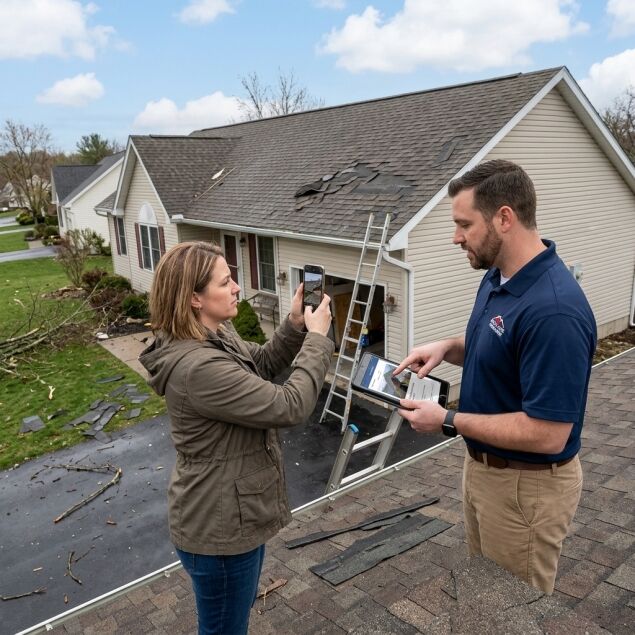
Start by photographing and videoing all visible damage from multiple angles and distances. Capture close-ups showing shingle damage, peeling, granule loss, or denting. Also photograph the overall roof condition, gutters, siding, windows, and ground-level debris patterns. If water is entering the home, document that too with photos of stains, wet insulation, or pooling water.
Create a written log that includes:
- Date, time, and type of storm (wind speed if reported, hail size, duration)
- Specific areas affected on your property
- Visible damage on the roof, walls, fascia, gutters, and landscaping
- Any interior water damage, leaks, or structural concerns
- Temporary repairs or emergency measures you’ve taken
Keep all documentation in one place (a folder, cloud storage, or email thread to yourself). Don’t discard any damaged materials yet. Adjusters sometimes request to see physical evidence, particularly for roof materials.

Actionable takeaway: Complete all photography and written documentation within 48 hours of the storm, before any cleanup or repairs begin.
Step 2: File Your Claim Promptly with Comprehensive Evidence
Insurance policies typically allow 30 to 90 days to file a claim after loss, but filing early is always smarter. Early filing prevents the insurer from claiming delayed notification, and it gets your claim into the queue faster.
Contact your insurance agent or company within the first week. Provide your policy number, date of loss, and a brief description of the damage. Ask specifically which documents they need and which forms you must complete.
When you file, include:
- Photos and videos from step one
- Written damage description with specific locations (e.g., “South and west-facing roof, approximately 40 percent of surface area”)
- List of any personal property damaged by the storm
- Proof of occupancy (utility bill or mortgage statement)
- Copies of any temporary repairs you’ve made to prevent further loss
If you’re uncertain about damage severity or extent, don’t minimize it in your filing. Provide what you’ve observed, and let the adjuster make the full assessment. Understatement in the initial claim can set an artificially low valuation that’s difficult to increase later.
Actionable takeaway: File your claim within 7-10 days with all documentation organized and clearly labeled by location and damage type.
Step 3: Work with an Insurance Claim Expert on Your Side
This step separates homeowners who recover fully from those who don’t. An insurance claim expert (often called a public adjuster or roofing professional trained in claim assessment) represents your interests by ensuring the insurer’s offer matches actual damage and repair costs.
Here’s what an expert does:
- Performs a detailed property inspection to identify all damage (including concealed damage)
- Calculates accurate repair costs using current market rates
- Reviews the insurer’s initial estimate for gaps or undervaluation
- Communicates with the adjuster on your behalf
- Negotiates if the insurance offer falls short of repair costs
- Explains coverage details and maximizes legitimate claim value
Insurance companies employ their own adjusters to evaluate claims. Those adjusters work for the insurer’s financial interest. Having a professional on your side who understands roofing damage, insurance language, and claim negotiation creates balance and ensures your property damage is properly valued.
Actionable takeaway: Engage a roofing professional or claim expert within 10 days of filing so they can participate in the adjuster inspection and assessment process.
Step 4: Navigate the Adjuster Inspection with Confidence
The adjuster’s site visit and report heavily influence claim approval and payout amount. Preparation matters.
Before the inspection, walk through your property and make a list of every area with damage. Walk it again with your claim expert if you’ve hired one. During the adjuster’s visit, stay present and available to point out damage and answer questions. Don’t argue with the adjuster, but do provide context: “We noticed this started leaking three days after the storm” or “This area is visible from the street where the hail impact pattern is consistent across the neighborhood.”
Show the adjuster your documentation, damage timeline, and any professional assessment reports. If your claim expert is present, they’ll ask clarifying questions about coverage interpretation and ensure nothing is overlooked.
After the inspection, request a copy of the adjuster’s report and photos. Review these carefully. If damage is minimized or missed, your claim expert can request a re-inspection or supplemental adjustment before the claim is finalized.
Actionable takeaway: Attend the adjuster inspection with your claim expert present, provide honest answers to all questions, and request a full copy of the adjuster’s report immediately.
Step 5: Secure Approval and Move Forward with Quality Repairs
Once your claim is approved, you’ll receive an insurance check (sometimes in two payments: initial assessment plus holdback after final inspection). At this point, your priority shifts to selecting a qualified contractor who can execute repairs to your insurer’s standards and your expectations.
Your insurance approval doesn’t obligate you to use any particular contractor. You have the right to choose based on reputation, warranty, timeline, and customer service. The contractor you select should be licensed, insured, and experienced in the type of repair your roof requires.
One critical step: ensure your final repair scope matches what your insurance covers. If the approved amount is less than the contractor’s quote, the contractor can work with you and the insurance company to present additional evidence of damage for a supplemental claim. However, this only works if repairs haven’t begun yet.
Actionable takeaway: Before repairs start, verify the contractor is licensed and bonded, understands your insurance requirements, and agrees to the approved scope and timeline.
How Our Insurance Claim Assistance Makes the Difference
We guide property owners through every stage of the claims process because we understand how insurers evaluate roof damage. Our team documents damage thoroughly, communicates professionally with adjusters, and ensures your claim reflects the true cost of repairs.
When you contact us after a storm, we perform a comprehensive damage assessment at no cost. We photograph damage systematically, identify both obvious and concealed issues, and provide you with a detailed estimate. If you’re filing an insurance claim, we give you professional documentation to include with your filing and represent your interests during the adjuster inspection.
Our experience with hundreds of storm damage roofing claims means we anticipate what adjusters will look for and ensure nothing is missed. We also help bridge any gap between insurance approval and actual repair cost if supplemental claims are warranted.
The North Star Advantage in Storm Restoration
Beyond claims assistance, we offer emergency tarping and temporary repairs to prevent further damage while your claim is being processed. A compromised roof allows water infiltration that compounds the original storm damage and complicates repairs.
We carry our own Zero-Regret Roof System, which combines premium materials with expert installation and 12 iron-clad written guarantees. When your claim is approved and you’re ready to repair, you get a roof built to withstand future storms, not simply patched back to pre-storm condition.
Our flexible financing options also work alongside insurance payouts. If your approved claim amount leaves a gap, we can structure financing so you’re not out of pocket for the difference.
Protecting Your Investment with Lifetime Workmanship Protection
We stand behind our work with lifetime workmanship protection. This means if an issue arises from our installation or repair work during your ownership of the property, we fix it at no cost. This protection exists regardless of insurance coverage, giving you genuine peace of mind.
Storm restoration isn’t just about returning your roof to code. It’s about creating a durable, long-lasting asset that protects your property and investment for decades. Our workmanship guarantee ensures that commitment is real.
Next Steps: Getting Your Storm Damage Resolved Today
If your property has sustained storm damage, don’t delay. Contact us today for a free damage assessment and insurance claim consultation. We’ll evaluate your roof, provide detailed documentation, and guide you through the claim process.
You can reach us by phone or through our website to schedule your inspection. If your situation is urgent (active leak, structural concern), mention that when you call so we can prioritize emergency tarping.
The right support in the first days after a storm transforms a stressful, uncertain process into a manageable one. We’re here to make sure your claim succeeds and your repairs are completed correctly.
